

How an A/B test works
In A/B testing, an existing version, known as the control version (A), is compared with a slightly altered variant (B). These changes can relate to various elements, such as the color of a call-to-action button, the wording of a headline, or the position of a form. The entire traffic or a representative sample is randomly divided between both versions, so that each user sees either the original version or the modified variant.
By comparing user interactions – such as clicks, time spent, or conversion rates – it is determined which version performs better. To ensure the results are valid, a sufficient sample size must be achieved. Additionally, confounding factors, such as seasonal fluctuations or technical issues, should be minimized. The version with significantly better performance is ultimately identified as the more successful one and can be implemented on a larger scale.
Elements that can be tested
In A/B testing, many different elements of a website or campaign can be analyzed and optimized. By making targeted adjustments, it can be tested which version achieves a higher user interaction or conversion rate. The following components are particularly suitable for A/B tests:
- Headings: Different formulations can influence attention to varying degrees.
- Call-to-Action (CTA): The position, color, or text of a CTA button can significantly change the conversion rate.
- Images and graphics: Different visual content can influence user behavior.
- Forms: Shorter or longer forms often have an impact on the number of completed interactions.
- Prices and Offers: Different pricing structures or discounts can influence different purchasing decisions.
- Layout and Design: The placement of elements can influence usability and thus user behavior.
Advantages of A/B Testing
A/B testing provides companies with a well-founded way to continuously improve their digital content and marketing strategies. Instead of relying on assumptions or subjective opinions, an A/B test delivers clear, data-driven results about which changes actually achieve the desired effect. By specifically comparing two variants, optimization potentials can be identified and implemented. The main advantages of A/B testing are:
- Data-driven decisions: Instead of making assumptions, optimization is based on actual user behavior.
- Increase in conversion rate: Through targeted testing, a website or campaign can be continuously improved.
- Risk minimization: Changes can be implemented gradually, so there is no abrupt risk to performance.
- Better user experience: By optimizing relevant elements, user satisfaction increases.
Best Practices for A/B Testing
In order for A/B testing to provide meaningful and reliable results, it should be conducted according to clear methodological principles. Poorly planned or hastily concluded tests can lead to false conclusions and leave optimization potentials untapped. To gain valid insights and achieve sustainable improvements, these best practices should be observed:
- Change only one variable per test: To obtain a definitive statement about the effect of a change.
- Sufficient traffic for meaningful results: A test should achieve a statistically relevant sample size.
- Test long enough: Depending on traffic volume, a test should run for at least a few days to weeks.
- Analyze results objectively: It is important not to prematurely terminate tests and not to draw hasty conclusions.
- Iterative optimization: A/B testing is an ongoing process – after a successful change, the next test should be planned.
A/B Testing Tools
Conducting and analyzing A/B tests requires specialized tools that make the process efficient and provide precise data. These software solutions allow testing different variants of a website or campaign, measuring user interactions, and making informed decisions based on real data. Here are some of the most well-known and powerful A/B testing tools:
A/B Testing vs. Multivariate Testing
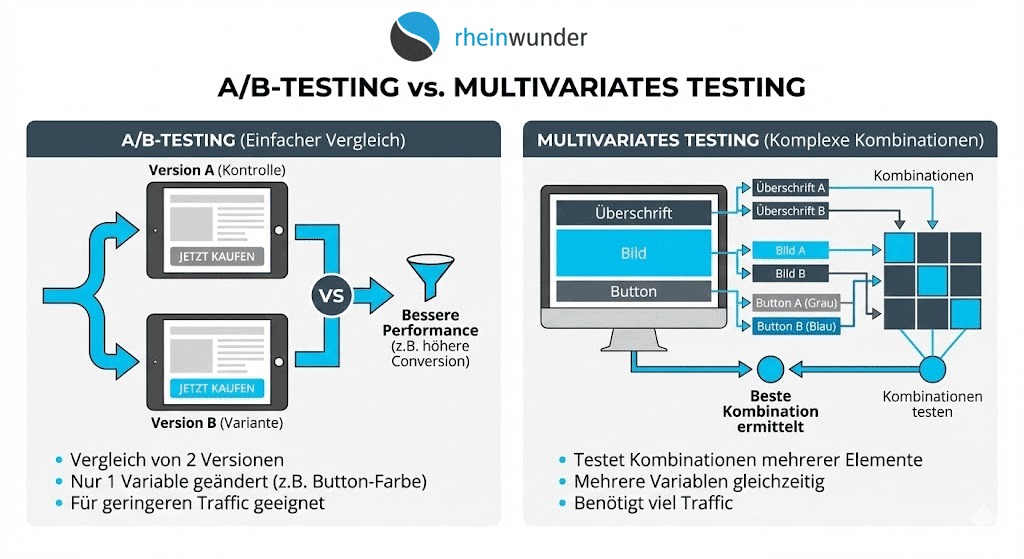
A/B Testing and multivariate testing are two methods for optimizing websites, marketing campaigns, and digital products. Both techniques are based on data-driven experiments, but they differ in complexity and the requirements for traffic and analysis capabilities.
A/B Testing – The targeted comparison of two variants
In A/B Testing, an existing version (A) is compared with a slightly modified variant (B). The goal is to test a single change (e.g., a new headline, a different button color, or a changed placement of a form) for its effectiveness. Traffic is randomly distributed between the two versions to determine which performs better.
Multivariate Testing – The analysis of complex combinations
While A/B tests analyze only one change per test run, multivariate testing (MVT) allows for the simultaneous examination of multiple elements. In this case, different combinations of several variables are tested to find out which configuration achieves the best performance.
When should one use A/B Testing or multivariate Testing?
- A/B testing is ideal when only individual elements are to be tested, e.g., a call-to-action, an image, or a headline. It is particularly suitable for websites with low to medium traffic, as it requires less data for valid results.
- Multivariate testing is useful when multiple changes need to be tested simultaneously. This is especially used on high-traffic websites or campaigns to make more comprehensive optimizations.
Optimize your conversion rate with A/B testing!
Do you want to find out which version of your website performs best? We at Rheinwunder are your experts in data-driven optimization and conversion rate optimization. Contact us for a non-binding consultation!